

Ben Reed concludes his journey through the history of the modern bar movement, stopping off in the years 2010-2020.
Read the first two editions of this series - 1990-2000 and 2000-2010.
And so to the final chapter of this meander through the decades of London’s modern cocktail scene – 2010-2020. You may require a short recap. The ‘pioneer generation’ had done their job and mostly survived the ravages of the ’90s. The bubble was supposed to have burst by now – it hadn’t and generations that followed were better established for it.
Critically, career paths had begun to both fork and widen, it was no longer a case of just getting out from behind the bar and away from the limitations that the job afforded. Not just the “bartender – bar manager – TIA – rehab – consultant” career/life progression model practised by many of the early adopters in the cold grey light of the cocktail renaissance dawn.
Public opinion was changing, bartending was beginning to be seen as a viable career, not by anyone’s parents – let’s not get carried away – but by the drinking public that we had successfully brought with us on this journey.
More and more young enthusiastic bartenders were piling into London from all corners of the globe. Though not from the US, never from there – the tipping culture here probably fed into that, and possibly laurel resting too.
A chief protagonist of the old NYC/LDN rivalry was my old mate Toby Cecchini, owner of the Long Island bar in Brooklyn and inventor of the Cosmo – and so the bane of every London and New York bartender’s existence in the ’80s & ’90s. He once remarked to me how he’d expressed disbelief when first told how evolved the London scene was. He then visited London at the end of the 00s and ordered a Satan’s Whiskers at a bar he was taken to, trying to catch the young bartender out (not at the actual Satan’s Whiskers, that would open a few years later). When asked whether he’d like the whiskers curled or straight he turned to his companion and laid down his flag: “I give up. You win.”
The twenty teens saw the mixed drink placed firmly in the public consciousness, and not just the cocktail cognoscenti, thanks to its democratisation. This was helped in no small part by London Cocktail Week but also the proliferation of bartender-owned bars and the innovation that ensued.
London Cocktail Club, Experimental Cocktail Club, Satan’s Whiskers, White Lyan, 69 Colebrook Row, The Gibson, Peg & Patriot, Scout, Nine Lives, The Hide, Happiness Forgets, Tayer + Elementary, Callooh Callay, Three Sheets.
None of these bars are on this list just for the ‘bartender owned’ criteria, these bars all brought something new to the table – they all progressed our industry and in turn influenced the rest of the world.
Many of these bars have closed recently due to London’s exorbitant rents, National Insurance increases and other hurdles thrown up by a seemingly uncaring government and similar issues that belong in another article. But to those that have survived… hats off.
The dominance of London was celebrated and, more importantly, documented by the arrival of a phenomenon that has become everyone’s post-work/staff-drink gripe. The awards ceremony. I’m personally a fan – for every bar that feels overlooked there have been plenty that have been given a step up. I’m all for anything that rightfully glamourises our industry and highlights burgeoning cocktail culture in previously unrecognised regions. Whatever side of the fence you’re on, they sure do help to keep track of which cities were doing what over any period and it was London that was winning it in the teens. The World’s 50 Best Bars was bookended by Milk & Honey in 2010 and The Connaught in 2020, and repeated cap doffing goes to Alex Kratena and Simone Caporale for their extended winning streak at the Artesian – #1 for four consecutive years, an enormous achievement, even if this was the decade before the rest of the world really showed up.
Engaging concepts
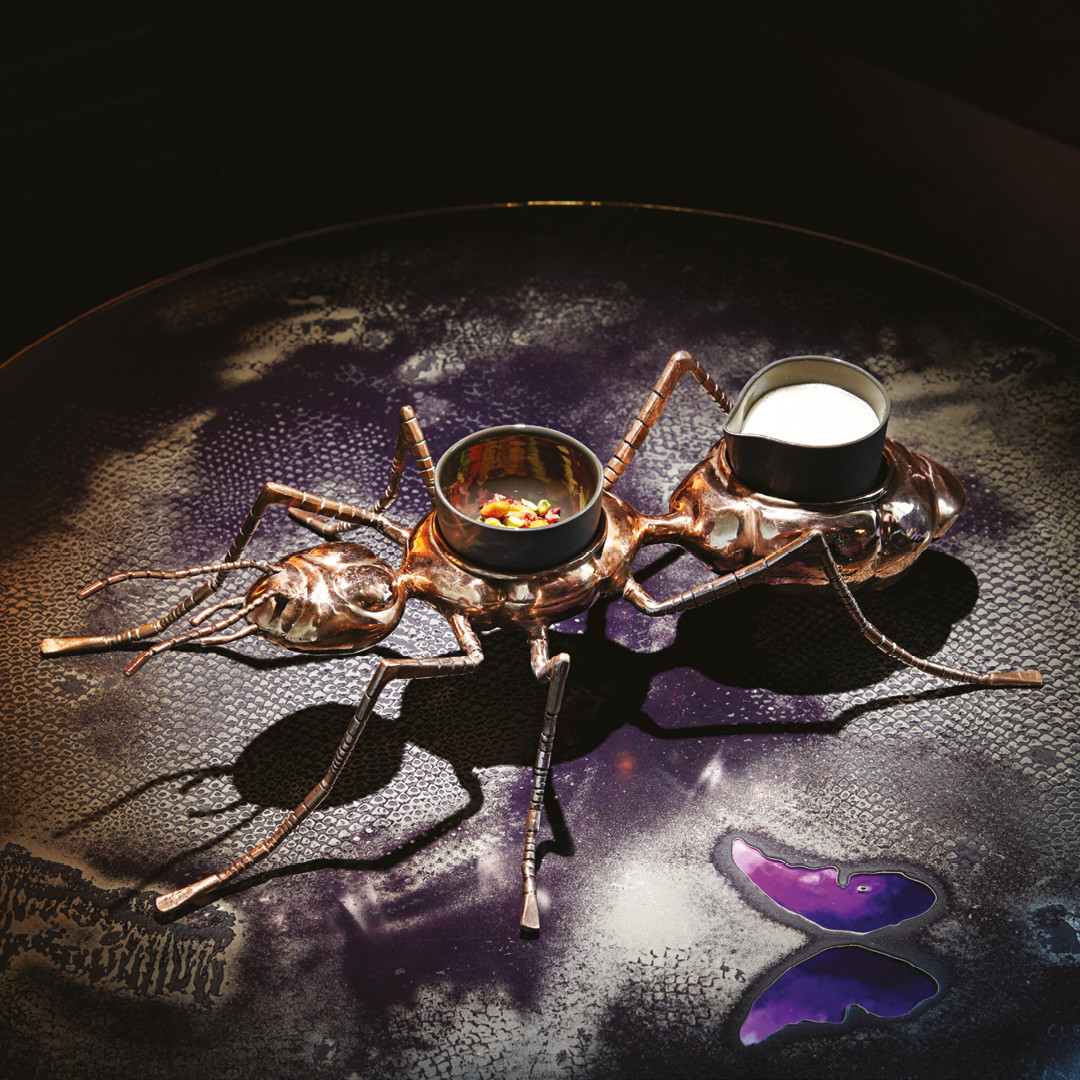
What they did can never be understated. Their serves were explicitly designed to engage multiple senses with smell, flavour and sight entwined on an experiential level. Engaging concepts like surrealism – one drink was presented in a copper ant.
Stuck in my memory (if it serves) was The Super Panda cocktail, which would be served on a paper lantern that was filled with mandarin scent. As the drink was placed on the pillow and it deflated, the scent filled the air around you.
The cocktail experience was beginning to outweigh the actual taste of the drink – though I’m sure the liquid was delicious (I don’t remember or really care to be honest).
There was also great technique at that bar. I once saw Alex ‘throwing’ a heavy red liquid – I imagine it was tomato juice. He did it while spinning slowing on the spot, making the liquid bend in the air. I’d never seen this done before, it was mesmerising.
2012 was a bumper year with seven bars from London dominating the top placements (Artesian, Nightjar, The Connaught, American Bar, 69 Colebrook Row, Callooh Callay and Happiness Forgets).
A court ruling instigated by those gents at Sipsmith concerning minimum sizes of distillation chamber enabled the craft distilling movement, certainly positively impacting and empowering the gin boom of that era and inspired innovative entrepreneurial bartenders looking to diversify while staying in the industry they loved. Bartender-created spirits brands the East London Liquor Company, Italicus, Portobello Road gin, Kamm & Sons aperitif, are notable London brands born of that time.
And the trends in London over that decade? Not all of them necessarily originated in London but we certainly picked up the ball and ran with it.
London had become a must visit for migrating bartenders and served as a trend and innovation springboard for the rest of the world. The size of London and the spoilt choice of bars meant a lot of these trends were happening simultaneously.
Here they are, as I remember:
The speakeasy revival: Dark rooms, hidden entrances, passwords on the door. Milk & Honey, Experimental Cocktail Club (loved its open-sided accessible bar), Nightjar. Hand-cut ice, house-made syrups and bitters, vintage spirits and forgotten cocktails (yes, I’ve stolen the title of this from Ted Haigh’s fantastic book that celebrated the movement – buy it, read it).
The modernist/experimental movement: 69 Colebrooke Row beat that drum first: rotary evaporators, centrifuges, sous vide ingredients driven… scent and flavour manipulation. The Prairie Oyster.
The cocktail as an experience: Artesian, Artesian, Artesian. Narrative-driven menus and multisensory engagement.
Cocktail menus that required a glossary: Was there a degree of shark jumping with Ryan Chetiyawardana’s first use of ambergris at Dandelyan? Nightjar and Oriole were pretty good at unrecognisable mystery ingredients too.
Sustainability and low waste: White Lyan in Hoxton, Ryan Chetiyawardana again and Ian Griffiths (went on to create global sustainability platform Trash Tiki) No ice, no perishables, upcycling ingredients, spent coffee grounds, citrus etc fermentation (kombucha), reduced single-use plastics. Scout, Nine Lives, the list goes on.
Ultra-refined minimalism: Elegant, spirit-forward drinks served in minimalist glassware at The American Bar. The Connaught with that infamous Art Deco Martini drinks trolley. Among the indies: Coupette, Scout, Tayer + Elementary. And, at the opposite end of the spectrum – maximalist cocktails. Marian Beke at Nightjar first then The Gibson. An unsung hero of the London bar scene (now Berlin’s gain). Super-convoluted cocktails with multiple ingredients, crazy glassware and ridiculous garnishes. Bars with back bars as Cabinets of Curiosity and the bartender as the curator weaving stories with disparate ingredients, techniques and garnishes.
Pre batching: Self explanatory. Hix, Three Sheets, Tayer + Elementary, White Lyan again. The impending lockdown certainly abetted this movement.
One of the more profound movements to arrive in London in this decade was the arrival on menus of alcohol-free cocktails that bartenders actually gave a shit about. I’m going to be lazy and say this coincided with the launch of Seedlip. For the first time, low/no cocktails weren’t just the alcohol-free version of existing cocktails or a jumble of juices and syrups, but crafted cocktails with a degree of gravitas – and prices to match, careful what you wish for right?
The low/no movement was born of this era. It manifested itself with the re-emergence of the Highball and reflected both consumer demand and a general feeling in the hospitality industry that we should probably start looking after ourselves better too – mentally and physically.
Somewhere along the way though, did we lose the art of customer engagement? Or was the consumer too busy staring at their phone?
I was surprised to hear recently that there’s been a mentality shift in young bartenders. All we wanted to do in our formative years was create the next modern classic. Dick Bradsell did it best of course and we all worshipped him, which he hated, so never to his face. The Espresso Martini was there when it all began and it’s still here today.
If there’s anything that a young bartender could take from my reminiscence, it’s that our industry wasn’t always thus. And it’s on the shoulders of the giants that I’ve mentioned in the last three pieces that this industry stands. If you see one of them in your bar, it’s a fair shout you owe them a drink.