

London didn’t just suddenly become the world-famous bar scene it is today, it evolved from a ragtag of starry-eyed bartenders in the 1990s. Ben Reed was one of them and tells the story of our humble beginnings.
I am now old enough to see the heyday of my bartending career reinterpreted in ironic form. Only last year I was asked to chair a panel discussion at BCB Berlin on ’90s drinks reimagined. My role was to explain what bartending in the ’90s was actually like, seeing as the next oldest people in the room were Alex Kratena and Matt Whiley – kids when I was first behind the bar.
There aren’t that many of us from that era left. We lost Dick Bradsell and Douglas Ankrah, Wayne Collins and Henry Beasant. For better or worse you’re left with me, Angus Winchester, Ian Burrell, Nick Strangeway, Dre Masso and a handful of other pioneering names you might recognise.
I’m going to bet if you’re a bartender now, you probably weren’t then. And if you were, that the story of how London’s cocktail revolution sparked into life is a little bit hazy. It’s pretty recent history but it’s amazing how the details get lost in the mists of time. I’m determined to lay down as much of this as possible. There was my aforementioned appearance at BCB and a few years ago I put on a talk about the 20 Defining Moments of the London Bar Scene – voted on by the industry’s great and good from then and now. And now this three-part, decade-bydecade series is my latest attempt to put to paper these heady, chaotic but ground-breaking days.
If you're a bartender in London or within its orbit, this is our history. This is how we became.
It was a simple time The easiest way to elucidate this cold, grey dawn of the modern cocktail renaissance is, I’m thinking, to make a list of things we did not have:
• There was NO internet. We mostly relied on Dick Bradsell for drinks recipes – I think he also owned a cocktail book.
• There was NO brand calling, no brand choice nor accessibility to anything different. Why stock more than one gin? Gin’s gin, right?
• There was NO training and therefore no real bar/spirits/ cocktail knowledge – just what your head bartender told you to do.
• There was NO career longevity. Seriously, we were all constantly looking to get a proper job, or at least thinking about it. The idea of mixology as a concept was yet to be discovered.
• There were NO brand ambassadors. Love ’em or hate ’em… bartenders teaching other bartenders about their brands was both a huge step change and an opportunity for career longevity.
• There were NO fresh ingredients. If you wanted mint, you used crème de menthe. My first memory of mint in drinks was in 1998 from a Moroccan restaurant off Regent St called Momo’s – in a Vodka Mojito.
• There was NO bartender community – apart from a bunch of old Italian dudes in ill-fitting white dinner jackets.
• There were NO cocktail competitions – unless you counted the ones where the participants used white gloves and tongs. Sorry for the dig UKBG, you’ve done better since.
• There were NO spirit-forward drinks. Consumer palates were undeveloped; it was fruity and sweet all the way.
• There were almost NO bartender-owned bars, then in 1999 Douglas Ankrah opened LAB, which blew us away – and the doors open.
What we had
So what did we have? A fucking blast. Super-enthusiastic customers who would binge drink due to draconian licensing laws (we could serve alcohol from 12-2pm then 5pm-11pm with very few exceptions). We had Neo Martinis. We had the Holy Italian Trinity of Peter Dorelli, Salvatore Calabrese and Alessandro Palazzi. And we had a strong desire to create the next contemporary classic.
In those days, bartenders relied on personality and charisma more than encyclopaedic, golden-era cocktail knowledge and an empirical understanding of high-end science equipment.
Obviously, there was no social media, so we still knew how to make eye contact with guests. And, most importantly, there was an urge to quickly evolve what we did, based on little more than the fear that people would move on and our bubble was soon to burst.
The drinks
And what were the cool kids drinking? Dick Bradsell’s drinks, but no Espresso Martinis (by any of its names). Polish Martinis, Russian Spring Punches, Brambles, Carol Channings, French Martinis and anything with cranberry juice. Cosmos… so many Cosmos. But also the Sea Breeze, Bay Breeze and Madras. We (clearly) weren’t snobs, just so long as the name of the drink didn’t contain reference to a sexual act or a body part. And it was all about vodka.
At the time, I was running a high-profile cocktail bar called the Met Bar – part of a then new wave of so-called ‘style bars’, which were a reaction to pubs, hotel bars, wine bars and cheesy flair bars, which were the only other places to get a drink in London then. There was Met Bar, Atlantic Bar run by Dick Bradsell, Alphabet in Soho, Douglas Ankrah’s LAB and the beginnings of Jonathan Downey’s Match empire (more about this in the next episode).
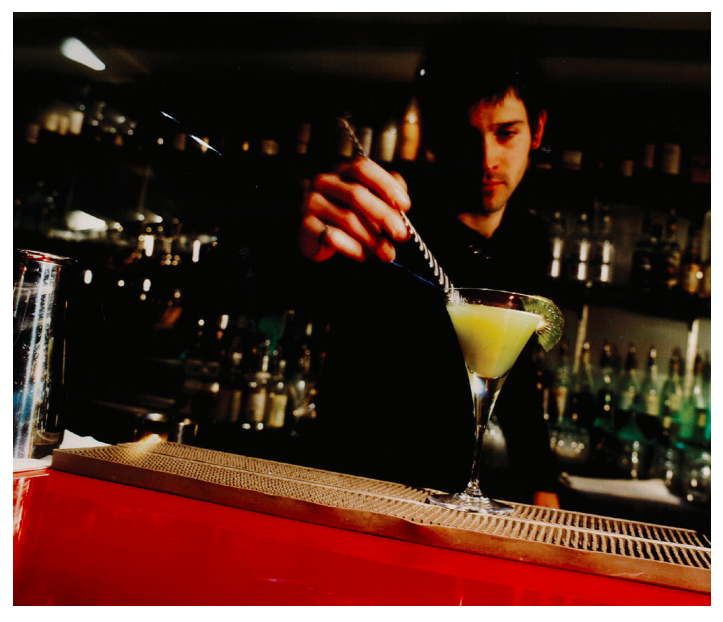
The Met was a doffing of the cap to what Ian Schrager was doing Stateside – a boutique hotel bar with a celebrity membership slant – and the UK’s first dedicated, contemporary Martini list. It was here I was asked to write a weekly column about the shenanigans of the bar industry in a column called Barfly for the Saturday Times newspaper.
Slowly, cocktail perceptions were shifting; from tawdry to aspirational. There weren’t many of us but as we reached the second half of the decade, little by little, the foundations of a community were laid down. When news of the London Bar Show came, it was something entirely new and way ahead of its time – years before Tales in New Orleans, BCB in Berlin (and now London). To my knowledge, it was the first of its kind anywhere. It was the first opportunity for bartenders to meet, swap stories, share techniques and recipes and, gasp, make friends.
It was around this time cocktail competitions emerged. They were revolutionary and another way by which we networked, learned and built relationships. I managed to win the UK’s first contemporary cocktail comp with Absolut. I created a labourintensive style of cocktail called the Fresh Fruit Martini that involved muddling fresh fruit, shaking and double straining. This was quickly picked up by Dre Masso and the boys at the LAB who started eschewing liqueurs in favour of fresh fruit in drinks like their Very Berry Collins. Like I say, baby steps.
Absolut was instrumental in bringing the industry together in the late ’90s and beyond. The brand even went as far as flying London bartenders to the US to nick cocktail ideas off the Americans. We got taken around New York by Dale DeGroff – something he called his Cocktail Safari, as you “drink until you see the giraffes”. It also sponsored Dale to come to the UK and teach us his flaming orange zest garnish for the Cosmo. It might have been my first ever training session. With King Cocktail himself. Talk about setting the bar high.
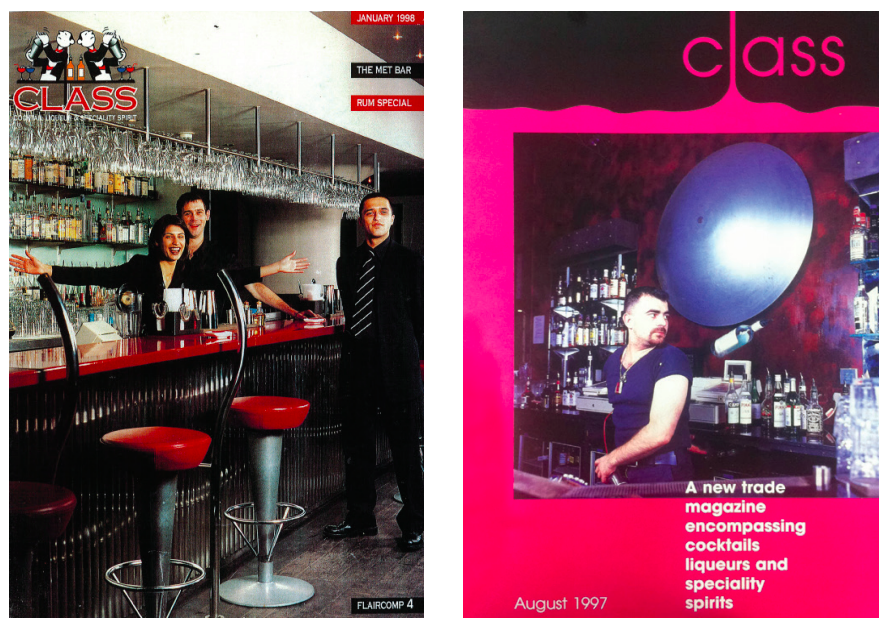
And to bring this full circle, in 1997, a visionary by the name of Simon Difford launched Class magazine. I think Met Bar appeared on the second cover. This publication – then, as now – served as the bartender mouthpiece for what was evolving in the UK. Things were picking up – we were starting to see the infrastructure of a cocktail industry.
Next in this series we will turn the corner of the Millennium, when things really started to evolve into the industry we know and love today.