


Crucible director and our regular expert Stuart Bale talks through the intricacies of finding the perfect amalgam of basic tastes.
The foundations of most great drinks come down to how you balance the five basic tastes: sweet, sour, salt, bitter and umami. Every drink contains at least some of these – the skill is knowing how they interact with each other and using that knowledge to create something that actually tastes delicious.
In previous articles we’ve talked about flavour and the best ways of extracting it. For me, flavour and taste are two different axes that both have to be balanced separately, but also need to interact with each other coherently. Of the five basic tastes, sweet and sour are the most important for balance.
The sugar-acid seesaw
Arguably the most significant aspect of this whole balancing act is the sugar/acid ratio – where you’re trying to balance palatable sweetness with sharp acidity. In nature, during fruit development the sugar ratio increases rapidly towards ripening until you get perfectly sweet, ripe fruit. Makes sense, right? The plant wants you to eat it and spread its seeds around.
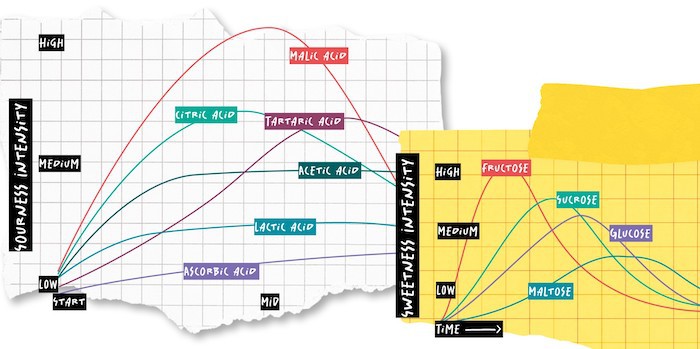
In fruit, the sugar most commonly found is fructose. It’s quite a bit sweeter than regular sugar – about 30% sweeter, actually. Honey is about 38% fructose, and agave is closer to 70% fructose. So when you’re swapping out sugar syrup for these, it’s really important that it’s not just a straight swap volume-wise. You'll end up with something disgustingly sweet and wonder what went wrong.
Also, worth mentioning: maltose, which isn’t as sweet but gives great body and a rich, dark taste. Useful stuff.
The War on Sugar
As part of the UK government’s War On Sugar, there’s inevitably been more interest in highly concentrated sweeteners – both artificial and natural. Stevia has been around for a while, and although it’s extremely sweet so you only need a tiny amount, it has this very distinctive aftertaste. Once you know it, it’s hard to escape – it’s like someone’s whispering ‘chemical’ at the back of your mouth. A more recent discovery is monk fruit, which I think has slightly more potential in that category. Still not perfect, but better.
Acids
The most common way of counteracting sweetness, in whatever form you choose, is citrus fruit on the day to day. As the name suggests, the main acid in lemons and limes is citric acid. Other fairly common acids you’ll find naturally in the bar would be malic (green apples), oxalic (rhubarb), tartaric (grapes) and lactic (yoghurt).
All these acids are available isolated as powders, so you don’t need to use the whole fruit. This gives you a lot of power to make micro adjustments to a drink’s taste without affecting the flavour.
For example, the fruits may be delivered to you at inconsistent levels of ripeness, or even just quality, so to ensure consistency in the drinks you need to adjust them. Tasted by themselves, all of the acids have slightly different properties and levels of sourness. Straight tartaric acid is reminiscent of licking a battery, if you’re familiar with that kind of thing.
Putting it together
Armed with this knowledge you can really start dialling in your cordials, sodas or mixers to make sure they perfectly complement the flavour of your drink. It’s the kind of thing that separates a drink that's ‘fine’ from one that makes someone go “fuck me, that’s good”. Next edition, we’ll make our drinks even better, delving into the nuances of salt, bitter and umami.