


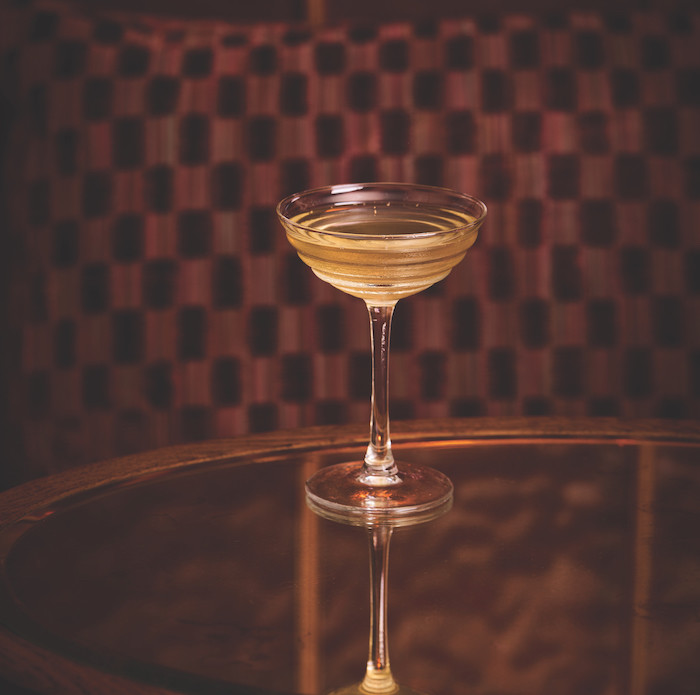
Tyler Zielinski gets the full story behind the evolution of one of the most creative cocktails of recent times.
If you’ve ever had any doubts about the magnificence and breadth of British produce, you clearly haven’t spent an evening at Nipperkin. There, beneath the bustling streets of Mayfair in what is essentially a Victorian drawing room fitted with a stylish island bar station, clay bottles with handwritten labels line the shelves around the intimate space. While some venues use these vessels purely as props, typically as an homage to the OG elixir slingers (ie apothecaries), Nipperkin’s have purpose.
Upon closer inspection, the labels reveal ingredients such as “cherry brandy”, “foraged cobnut liqueur”, “British dry amaretto” and “fennel absinthe”. Perched on a discreet shelf in another corner of the room are large jars filled with miscellaneous liquids mixed with unidentified British produce. It all feels a bit mad scientist; and when former head of bars for Creative Restaurant Group Angelos Bafas is in the house – he remains the group’s consultant – that sentiment isn’t too far fetched given his distinctive look and enthusiasm. Indeed, Bafas is a man mad about flavours – particularly those derived from the UK.
Any guest who expresses a modicum of intrigue about his team’s various concoctions gets a story about provenance and process before actually getting to taste something they’ve likely never experienced before.
Unlike most prep-heavy cocktail bars that pre-batch and/or stow away all their most intricate liquids, Nipperkin bottles and uses these novel creations as vehicles for education, pouring flights of hyper-seasonal ingredients for anyone who
is curious to taste the best
of Britain.
It’s a feat that’s especially appreciated when considering more adventurous cocktails on their menu, such as the green and savoury Black Mustard & Shiso, a Gimlet-style serve that appeared on the bar’s debut menu in 2023, and has evolved each year since.
“I believe we must have been one of the first bars to ever use black mustard in a drink,” claims Bafas. Ironically, the plant was mostly used because the bar had mistakenly ordered a human-sized volume of the foraged herb. But some of the best cocktails are results of happy accidents, as many bartenders, including Bafas, can attest to.
“Its first iteration was a Black Mustard Gimlet [sans shiso], which was simply two ingredients: gin and black mustard cordial,” says Bafas. “I think we are in the fourth stage of this recipe now, which we all agree is the final one.
“We realised that the drink needed more depth and complexity, so we added the shiso notes as an infusion into the blend of spirits and also added two different components of ginger.”
When initially working with the herbs, R&D started with the leaves, which Bafas had never tasted until he had mounds of the product to work with. The team tried to find the best way possible to evoke the black mustard aroma; and, with plants, they first had to determine whether the leaves were best infused into liquids in their raw, fresh form, or after being dehydrated. Then, they’d figure out the ideal length of infusion time. Bafas ended up coming to the conclusion that herbs should be infused “fresh in booze” and “dry in water”. It’s a law that’s practiced in the making of the final version of the Black Mustard & Shiso.
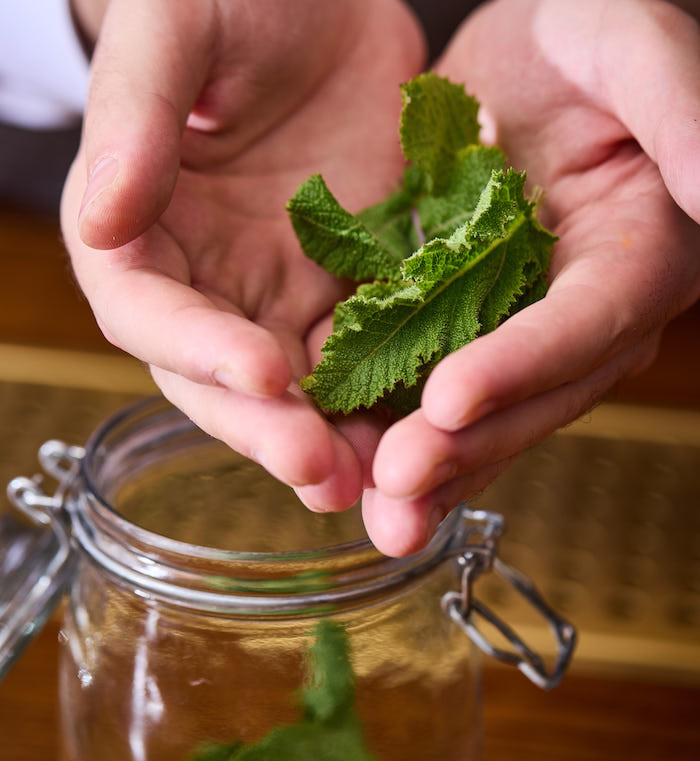
“The spirit we make now is a very simple maceration of grated British wasabi, foraged black mustard and shiso leaves into neutral grain,” says Bafas, who adds that the trick for maximising flavour in this fresh herb infusion is to oxidise the leaves before steeping in alcohol (oxidise by gently rubbing the herb with your hands). “The oxidisation process allows more aromas to be released from the leaves, contributing to a richer, more pungent infusion.”
In addition to the multi-herb infusion, the bar creates two separate cordials for black mustard and shiso respectively. Using a process similar to tea making, the leaves are dried, steeped in water for 20 minutes, then balanced with sugars and acids.
Adding depth
To add complexity and depth of flavour, Bafas added more spice in the form of ginger. “The ginger we use now is a bit more technical as it is a vinegar we make from scratch,” explains Bafas, who initially only used ginger liqueur to season the original Black Mustard Gimlet. “We juice homegrown organic ginger, then we fortify it with alcohol and a vinegar mother (we are looking for an alcohol content of around 7-8%). Once we achieve that abv, we pump some air into it for aeration, allowing the mother to turn alcohol into acetic acid.” This fermentation takes about two months before being rested for another three months, during which time Nipperkin introduces a hint of chilli pepper to enhance the spiciness of the vinegar. After the five-month period, it’s ready for use – a subtle reminder that time is one of the most important, yet most underappreciated, ingredients.
While the cocktail’s name would have guests believe it was the shiso that really evolved the serve into its final iteration, Bafas says it was the ginger vinegar’s brightness and acetic acidity that really took the Black Mustard & Shiso to new heights. Instead of the drink being too sweet or “gluey”, as can happen with sugar-rich cordials, the small dose of vinegar added a much-needed freshness.
“The idea behind the drink was always to create a peppery, fresh and herbaceous Gimlet with locally sourced wild produce,” says Bafas. “And the result tastes like a green salad with a ginger vinaigrette.”
Like most, if not all, of the drinks you’ll find at Nipperkin, the Black Mustard & Shiso proves that innovation doesn’t always come from exotic imports or flashy techniques. It can also derive from a deeper respect and understanding for what grows nearby, and taking the time to express those ingredients in their optimal form.