



Bartenders can change the world, says Hamish Smith after seeing what Jean Trinh has achieved through his bar and social projects in Colombia.
When Jean Trinh steps out of his Jeep in the remote forest of Los Montes de María in Colombia, children from all directions run towards him. Not because he is one of the world’s most famous bartenders and owner of the decorated Alquímico – far from it – but because he has changed their lives.
Twenty years ago, this was war-torn, FARC-controlled country, deserted by its inhabitants, its land lying fallow. When hostilities relented, its people returned and poorly paid monoculture pervaded, the forest seen as a source of wood, not fruit. If there was a market for their crops – yam, yucca, rice - it was barely enough to sustain them.
When Trinh’s project Comunidad with local farming co-operative AsocOman started in 2021, the provision of water came first. The farmers of this tropical ‘dry forest’ are first to say it: “Water changed everything”. For the people but also the crops – soon aromatic herbs were able to be grown and with higher-value crops came the financial freedom to stop clearing forest and allow rare regional fruit to ripen on trees. Slowly, the full bounty of this uncharted biome revealed itself and now organic, regionally-unique produce has become the farmers’ livelihood.
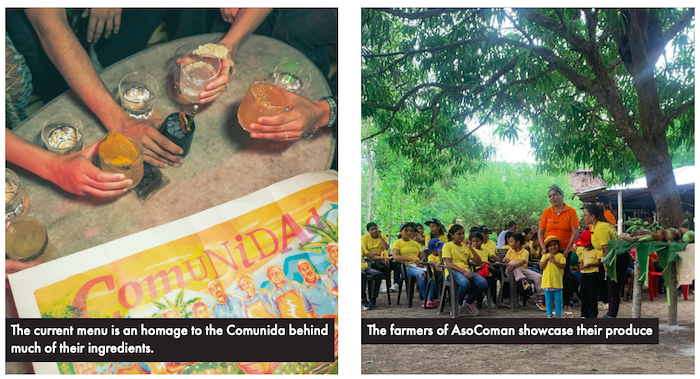
Trinh’s contribution was partly financial, but mostly about providing opportunity. His connections with the gastronomic world enabled him to create a market where previously none existed. The network provided Colombia’s burgeoning and ingredient-curious hospitality scene with produce that they previously couldn’t access. For this, and schemes like it, Trinh now has a dedicated team – after all, it’s no small undertaking. Just here for this project, there are 42 venues involved in the network that supports 200 local people.
The impact has been financial, ecological and social. Where once men farmed and women were unemployed and unempowered, the scheme has been transformational. Women of the village – now skilled in the best of bartender techniques – can process fresh ingredients, increasing their lifespan, use and marketability.
This forgotten part of Colombia is now a small but thriving organ of the country’s rich tapestry of gastronomy. Not least Trinh’s own bar, Alquímico, much of the fresh produce of which is grown by the farmers of AsocOman. About 25% of what they use comes from Trinh’s own farm, which leads us to another chapter in the adventures of Alquímico.
Alquímico
A colonial three-floor mansion house in the heart of Caribbean coastal town Cartagena, Alquímico was a thriving bar gaining a reputation fast, when, at less than four years old, Covid closed it.
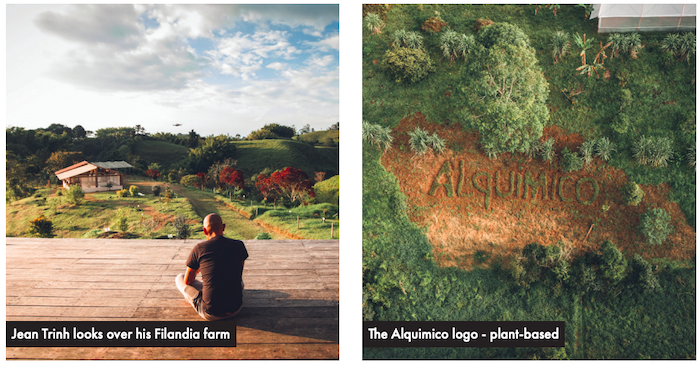
At first Trinh tried to keep his 55 staff on the payroll, but when the money ran out, he had to think creatively. He offered his fl at in the city to any of his staff who didn’t want to up sticks and leave for a 28-hour bus ride through Colombia’s interior to his Filandia farm – land he’d bought with no real plan two years before.
Twenty four of the team made the trip into the heart of Colombia’s hilly coffee district to a farm with no farm house. Trinh had asked a local tradesman to build them a basic home a month previous, but when they arrived they found he’d got as far as the foundations. Out of necessity, bartenders became builders, Trinh says proudly. You wouldn’t know the house – a substantial eight-bedroom property with panoramic views across the farmland – was built by anyone other than professionals.
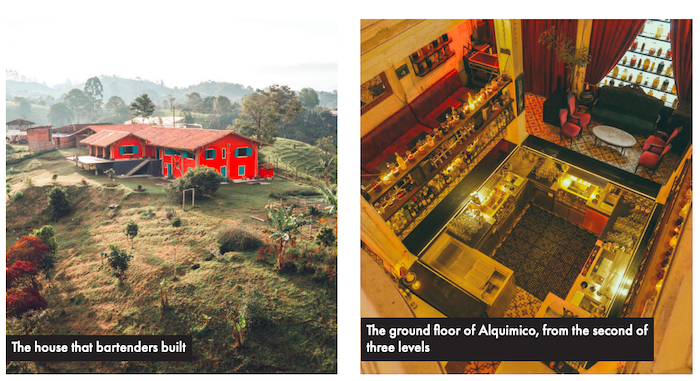
Farming was also soon underway. After all, money was short and anything they could grow replaced the need to buy. The days were long and the diet purely vegetarian, but the 24-strong team stayed for five months – some as long as nine – until Covid rules relented.
During that time they created a farm that now has more than 200 different crops – pretty much every fruit you can think of. More than plants, there’s honey produced from their own hives, which is used to make meads that star at Alquímco.
The current menu at Alquímico pays homage to its AsocOman farmers, but also features handmade or grown ingredients from his own Alquímico farm – be it hydrated ingredients, infusions, or even homemade cheese.
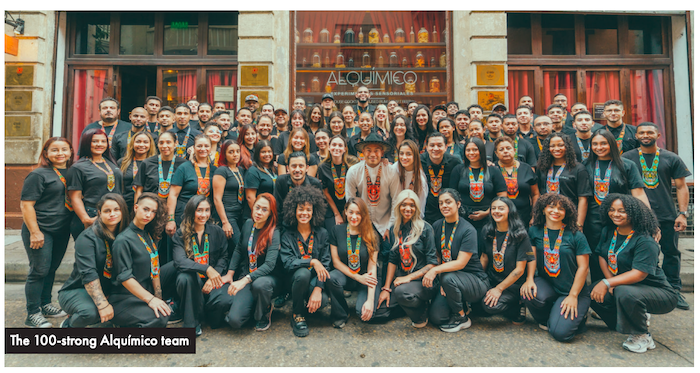
These are bartenders who – when it came to it – became able builders and farmers. Now they are part of a 100-strong team that works at Alquímico – by most people’s reckoning, one of the best bars in the world.
Under the watchful eye of Trinh’s partner, Paola Oviedo, Alquímico is a palace of thronging hospitality that serves up to 1,200 people a night. It bounces with Latin spirit – the female bartenders on the ground-floor courtyard bar seemingly orchestrating everything that happens around them. It might not be obvious to the revellers, but this is a bar that has purpose beyond party.
The ambition of the next menu from Alquímico goes even further. The edition for the first floor celebrates the Comunidad community project, and will fund an “AsocOman’s processing building” and a “school for the children” of the farmers, Trinh says. Profits from the second-floor menu will fund “an academy for bartenders (mainly from humble neighbourhoods of Cartagena)” and a “music foundation” for disadvantaged teenagers.
The third floor’s drinks draw ingredients from the Alquímico farm and have a goal to “help reforest farms in Finlandia with native trees”.
It just goes to show you, bartenders really can change the world.