

Longtime 50 Best Bars collaborator, Hamish Smith, offers his analysis of this year's list.
The headline: Bar Leone has won The World’s 50 Best Bars 2026! But let’s not feign too much amazement. This much-loved Roman-themed Hong Kong bar was pretty much everyone’s favourite to repeat its 2025 victory and become a double champion in 2026.
A gargantuan feat no less, and one not achieved since Connaught Bar’s back-to-back in 2020-2021, before that Artesian’s quadruple (2012-2015) and Milk & Honey London’s debut double (2009-2010). It has to be said, a few years ago it was starting to feel like extended stays at the apex of The 50 Best Bars were over, but as soon as Bar Leone shot to the top, you had a feeling its ‘cocktail popolari’ had staying power.
Bar Leone’s single mindedness in mastering the simple pleasures of Italian hospitality gets a lot right – including timing. Just when the industry was starting to tire of overwrought drinks making and hyperbolic menus, it went the other way. It zigged when others zagged.
Bar Leone’s win means it’s now two triumphs for Hong Kong, taking the city past Mexico City’s single victory (Handshake Speakeasy in 2024) and drawing it level with Barcelona (Paradiso in 2022 and Sips in 2023). New York has three wins (PDT in 2011, Dead Rabbit in 2016 and Dante in 2019) and London has 10 (spread across Milk & Honey in 2009-2010, Artesian in 2012-2015, American Bar in 2017, Dandelyan in 2018, and Connaught Bar in 2020-2021). It’ll be a while before any city chases down London’s record, but the trend is set – it’s been five years since London took the top spot and eight for New York – times aren’t a-changing, they already have.
Geo-paradox
This year we also saw the joint most geographically varied top 10 with nine cities contributing the 10 bars. The top 20 was also the joint second most globally strewn of any year, with 15 cities represented.
The global trend – long discussed in these pages – is one of the levelling up of bar standards as information, expertise and talent spread out around the world. London and New York have featured 135 and 108 times across the 18 lists and remain cavernous in depth and talent, but increasingly it feels less likely than a decade ago that these two markets will spawn a champion bar. The conditions for launching world-renowned bars (usually an equation of talent, capital and audience) now exist in many markets. This is a multi-polar world.
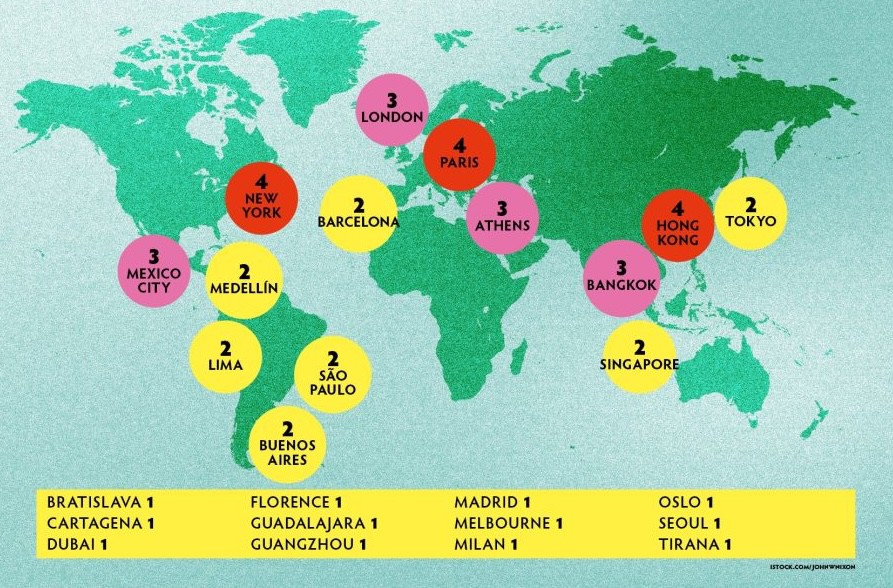
The cocktail capital – a title given to the city with most bars in the list – feels less and less the meaningful moniker. This year the cities with the most bars are Hong Kong, Paris and New York, but they only contributed four bars to the list (as would have London, almost certainly, if not for the temporary closure of Tayer + Elementary). With three are Mexico City, Bangkok and Athens, while eight cities contributed two bars each.
So the list is getting more geographically diverse – actually no. The 26 cities represented this year is precisely the average across the 18 editions. The biggest spread was 29 cities in 2010 and 2025, with the low point 19 bar scenes represented in 2019.
What we’re actually seeing is a group of about 10 or so bar scenes that contribute two to four bars per list. Over the past five years London and New York both contributed 4.2 bars on average, while for Mexico City it was 3.2, Athens 2.8, Paris 2.6, Singapore 2.6, Buenos Aires 2.6, Hong Kong 2.4, Barcelona 2.2, Bangkok 2.2 and Tokyo 2. An international operator looking to open the next big hit could do worse than set up shop in these cities.
You might observe – as many do – that the list feels very skewed to Tier 1 cities, which is a leaning of any list based on worldwide travel and voting on actual experiences. But The 50 Best Bars does also reveal venues from smaller cities too (in stature if not population). Medellín debuts this year with two bars in the list and, allied to coastal town Cartagena, that’s three bars from Colombian cities outside of the capital. Guadalajara from Mexico is present and Guangzhou in China featured again too – perhaps aided by its proximity to Hong Kong – while Italy has always contributed bars from a spread of cities with Florence and Milan featuring this year.
Who’s in, who’s out
The bombshells of the pre-announced 51-100 list revealed the craters we would find in the 1-50. Superbueno dropped from 12 to 61 – one of the bigger falls we’ve seen. CoChinChina from 26 to 56, Baba au Rum from 27 to 55. Six fell from positions in the mid 30s. Among the old timers that exited are Panda & Sons, Salmon Guru, Maybe Sammy, Scarfes and Drink Kong.
Those are some absent big names, but actually 17 dropouts (34%), while much more than last year (16%), is about the average over the 18-year history of the list. But part of the surprise was not just the size of the names, but the positions they fell from – those that landed in the 51-100 list (15 of 17 to drop out) fell an average of 36 places.
The safe zone
It begs the question: is there a safe zone from which a bar is unlikely to fall from the following year? The conventional wisdom would have it that the top half of the list is a pretty secure footing but, digging into the data, that doesn’t stand up to scrutiny. First, it should be said there will never be a position from 1-50 from which a bar will have safe passage for the simple reason that the poll is conducted each year afresh, but also because of what you might call the Artesian effect. The Langham bar was named Best Bar for a fourth consecutive time in 2015, then bombed out of the list in 2016.
But mathematically speaking, there is an inflection point at which you are more likely to stay than not. Over the history of the list there has been a 90% chance of a bar from the top 10 retaining its place the following year. From rankings 11–20 it is a 79% chance at staying and from positions 21–30 it’s 59%. In the range 31–40 it’s a 49% probability, while 41–50 is 41%.
So, the magic position is 30 – here you have a marginally better chance of staying in than leaving the list. There are though some caveats, which might make mid-table bars feel a bit more confident of a longer stay.
First, for those that enter the list, the stay lasts on average 2.8 lists.
This number is, of course, dragged down by the one-timers (49% of bars) and inflated by the serial members – more than 60 bars have registered five lists or more. Within that are the Legends. Nine bars have made 10 lists and a further five have made nine appearances each – not many are still in the list but one of them, Paradiso, was named this year’s Legend of the List. Himkok (10 lists) then Benfiddich (9) are future contenders for the title.
Bars also drop out not because they are necessarily unpopular among voters but because they close or rebrand (example Dandelyan in 2018), temporarily shutter (think Tayer + Elementary this year), and have seen significant changes to personnel (the aforementioned Artesian in 2015 or Two Schmucks in 2022).
It’s also worth saying that we are in a period of relative calm. The more volatile years of The 50 Best Bars were in 2009-2012 when the list was still establishing itself and in the Covid years. If the data is captured from a ‘normalised period’, the tipping point of retention comes at position 40, not 30.
And besides, dropping out isn’t always terminal. Not – to quote 2000s footballer manager Iain Dowie – if you have “bouncebackability”. One in seven fallen bars finds its way back into The 50 Best Bars at a later stage.
This article was written by Hamish Smith in his Drinks International (and CLASS) capacity. He is also the 50 Best Bars Academy Chair for UK & Ireland.